Eating with the Seasons: Nutrition, Sustainability, and the Real World Trade Offs

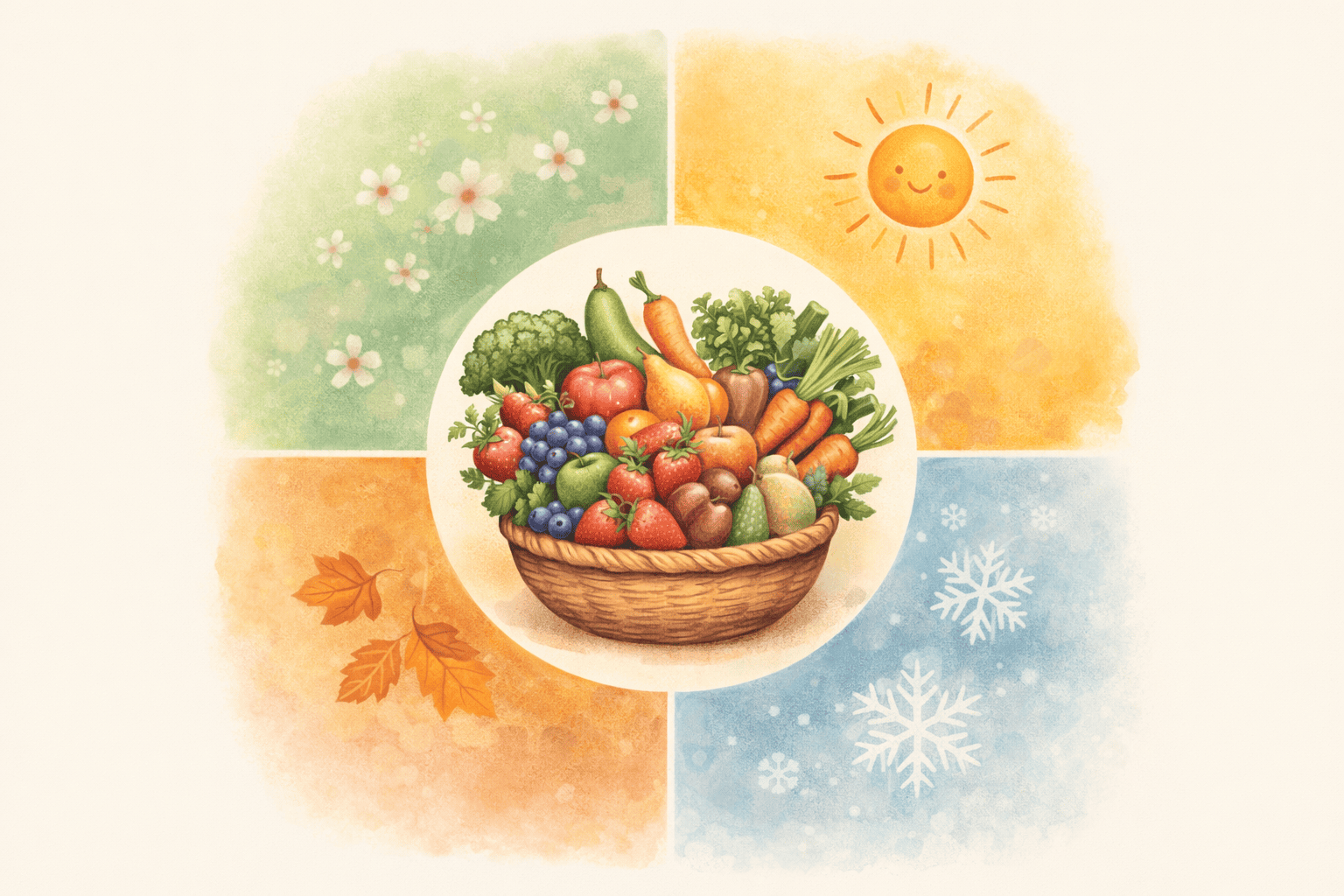
Seasonal eating gets marketed as a simple win: better taste, better nutrition, better for the planet, and easier on your wallet. There’s truth in all of that but it’s not the whole story. “Seasonal” can mean different things (local vs. global seasonality, fresh vs. stored, outdoor-grown vs. heated greenhouse), and the sustainability and health impacts depend heavily on how food is produced, stored, transported, and purchased.
A more useful way to think about seasonal eating is as a strategy not a purity test. It can help you eat more fruits and vegetables (a major public-health priority), diversify your diet, and sometimes spend less. But it also comes with limitations around access, convenience, and even environmental trade offs that don’t always match the popular narrative.
What “seasonal” actually means (and why definitions matter)
Many consumers treat seasonal and local as synonyms, but they’re not the same thing. A food can be produced in its natural growing season somewhere in the world and shipped (global seasonality), or produced and consumed within the same climatic zone during its natural season (local seasonality). The “best” choice depends on the production system, storage methods, and what the alternative would be.
This definitional mess matters because it shapes the claims people make. “Seasonal is always greener” is a slogan not a guarantee.
The nutritional case: potential benefits and where the hype goes too far
Pros: freshness, variety, and micronutrients
Nutritionally, the strongest argument for seasonal eating is practical: it can nudge you toward more fruits and vegetables and more variety across the year, which helps widen your micronutrient and phytochemical intake.
There are also plausible quality advantages when produce is eaten closer to harvest. Once produce is picked, certain nutrients (notably vitamin C) can decline over time during storage, so shorter time between harvest and plate can help preserve nutritional quality.
Seasonal eating can also support dietary diversity in a way that feels natural rotating produce with what’s abundant can prevent “same foods, every week” patterns that narrow nutrient exposure.
Cons: “fresh” is not always superior and preservation isn’t the enemy
Two reality checks matter:
Frozen produce can be nutritionally equivalent to fresh. Flash freezing soon after harvest helps preserve nutrients, even if texture changes make it less appealing for some dishes.
Some processing can improve bioavailability. For example, processed tomato products can have more bioavailable lycopene and beta carotene than fresh tomatoes.
So a nutrition forward seasonal approach is not “fresh only.” It’s “best available form that helps you eat more produce.”
Canned foods can be slightly lower in some water soluble nutrients if you discard the liquid, but they still provide nutritional value and can play a role especially when cost and access are constraints.
The sustainability case: benefits, trade offs, and common misconceptions
Pros: fewer “long and complex” pathways sometimes
Seasonal eating is often framed as a sustainability lever because it may reduce reliance on long distance transport and energy intensive off season production.
It can also align with supply chains that build community connection and awareness (e.g., short supply chains, CSA style models), which some research links to stronger seasonality awareness and motivation.
Cons: local is not automatically lower carbon
A key finding in sustainability research is that production method can matter more than distance. Case studies show that certain foods produced out of season in heated greenhouses can have higher greenhouse gas emissions than the same foods grown naturally in season elsewhere and transported.
More broadly, seasonality’s environmental gains may be real but relatively small compared with bigger levers like reducing food waste or shifting away from high emission foods.
Seasonality, resilience, and food security
A food system that relies solely on local seasonal production can be less resilient because crop production is vulnerable to climate variability. Increased extreme weather can affect yields, raise prices, and even alter nutrient composition.
There are also economic realities: supplying only local markets may not be viable for many farming systems, and farmers markets represent a small fraction of total farm sales so “just buy local seasonal at markets” isn’t a scalable policy solution by itself.
The cost case: when seasonal saves money and when it doesn’t
Pros: supply and demand pricing often favors in season produce
In season foods can be cheaper because supply is higher and there’s less need for long distance transport and refrigeration.
Cons: price and access are not equally distributed
Two important complications show up in the literature:
Access is unequal. Even if in season produce is cheaper in theory, not everyone has farmers markets nearby, flexible time to shop, or transportation.
Seasonal eating can carry a “lifestyle premium.” Qualitative research found a social divide where eating seasonally as a deliberate value based practice can skew toward higher socioeconomic groups, while others may prioritize price and practicality over seasonality ideology.
At the household level, the most realistic cost strategy is often a hybrid: fresh when abundant + frozen canned when needed.
The “pros and cons” summary
Pros
Can improve taste and encourage trying a wider variety of produce.
Supports dietary diversity and potentially higher nutrient retention when eaten closer to harvest.
Often cheaper in season; may reduce certain transport/storage costs.
Can support sustainability oriented supply chains and local economies in specific contexts.
Cons
“Seasonal” is inconsistently defined, local not equals automatically sustainable.
Heated greenhouse off season local production can be more emission intensive than imports grown naturally in season.
Environmental gains can be modest compared with other actions like reducing food waste.
Access barriers (time, location, price volatility) and equity issues affect who can “eat seasonally” in practice.
Fresh only approaches can increase waste; preservation can be environmentally and nutritionally sensible.
If you want seasonal eating to work in real life nutritionally, financially, and sustainably aim for flexible seasonality:
Prioritize produce intake first. Fruits and vegetables are strongly linked to health, yet intake remains low in many populations; availability and affordability matter.
Use fresh, frozen, and canned strategically. Frozen can be nutritionally equivalent; canned still counts.
Buy “peak season” items for freshness and cost, then preserve. Freezing, drying, and canning can reduce waste often a bigger environmental win than chasing a strict seasonal rule.
Focus on high impact sustainability moves alongside seasonality. Reducing waste and making broader diet shifts can outperform seasonality alone.
Respect budget and bandwidth. Building variety gradually can be more sustainable for a household than forcing constant novelty.
Seasonal produce guide: fruits and vegetables by season
(Examples for many U.S. regions your local seasonality will vary by climate and growing zone.)
Spring
Fruits: strawberries, cherries, apricots
Vegetables: asparagus, peas, artichokes, spinach, arugula, radishes, spring onions
Summer
Fruits: berries (blueberries, raspberries, blackberries), peaches, nectarines, plums, melons, grapes
Vegetables: tomatoes, cucumbers, zucchini/summer squash, corn, bell peppers, eggplant, green beans, basil
Fall
Fruits: apples, pears, figs, pomegranates, persimmons, cranberries
Vegetables: pumpkin, winter squash (butternut/acorn), sweet potatoes, carrots, beets, cauliflower, broccoli, Brussels sprouts
Winter
Fruits: citrus (oranges, grapefruit, lemons), kiwi, dates
Vegetables: cabbage, kale, collards, Brussels sprouts, turnips, parsnips, rutabaga, onions, mushrooms.
Bottom line
Seasonal eating is worth doing but it’s most powerful when it’s practical, not performative. The best “seasonal” pattern is the one that increases your fruit and vegetable intake, reduces waste, fits your budget, and makes sense for your region while acknowledging that sustainability depends on the full food system, not just the label in the produce aisle.
References
Harris, J., de Steenhuijsen Piters, B., McMullin, S., Bajwa, B., de Jager, I., & Brouwer, I. D. (2023). Fruits and vegetables for healthy diets: Priorities for food system research and action. In J. von Braun, K. Afsana, L. O. Fresco, et al. (Eds.), Science and innovations for food systems transformation (Chapter). Springer. https://doi.org/10.1007/978-3-031-15703-5_6
Macdiarmid, J. I. (2014). Seasonality and dietary requirements: Will eating seasonal food contribute to health and environmental sustainability? Proceedings of the Nutrition Society, 73(3), 368–375. https://doi.org/10.1017/S0029665113003753
Merschel, M. (2024, July 12). The ripe stuff: Why seasonal eating can be a healthy delight. American Heart Association News.
www.heart.org
Régnier, F., Dalstein, A.-L., Rouballay, C., & Chauvel, L. (2022). Eating in season—A lever of sustainability? An interview study on the social perception of seasonal consumption. Sustainability, 14(9), 5379. https://doi.org/10.3390/su14095379
Shaw, T. (2025, April 15). Are local, seasonal foods healthier? Dietitians weigh in. CU Anschutz News.
Vargas, A. M., Pinto de Moura, A., Deliza, R., & Cunha, L. M. (2021). The role of local seasonal foods in enhancing sustainable food consumption: A systematic literature review. Foods, 10(9), 2206. https://doi.org/10.3390/foods10092206